Key Takeaways
- The 5 paragraph essay format organizes writing into introduction, three focused body paragraphs, and a conclusion.
- Each body paragraph proves one clear reason connected directly to the thesis.
- Transitions link ideas so the essay reads as one argument, not separate parts.
- The conclusion restates the claim and explains overall meaning, giving the paper a finished, coherent structure.
What Is a 5 Paragraph Essay?
The 5 paragraph essay format is a structured academic writing model that organizes an argument into five sections: an introductory paragraph with a thesis, three body paragraphs that each present one supporting idea, and a concluding paragraph that restates the main point. The structure guides logical development, keeps the topic focused, and helps the reader follow reasoning from claim to final conclusion.
Structure Makes Writing Easier
EssayWriter maps out essays carefully, step by step.
Get Help

5 Paragraph Essay Outline
The 5 paragraph essay structure includes an introduction, three body paragraphs, and a conclusion arranged in logical order. Each section has a clear role, so ideas build step by step. Next, we break down every part and show what to include in each paragraph to keep the essay organized.

Paragraph 1: Introduction
The introductory paragraph should contain several clear elements that prepare the reader for the essay:
- Background context that helps the reader understand the topic and why it matters
- A brief narrowing toward the specific problem or question the essay addresses
- The thesis statement clearly stating the claim and main ideas that will be supported
- Key terms or subject details so the reader knows exactly what the discussion covers
- If responding to a source, the title and author can appear naturally in the opening
- A final sentence that signals the direction the body paragraphs will follow
Paragraph 2: Body Paragraph
- The first body paragraph develops one clear idea that supports the thesis.
- The topic sentence introduces the main point and directly connects it to the thesis, so the reader immediately knows what this section will prove
- Supporting sentences present specific evidence and detailed explanation showing how the example actually proves the claim, instead of leaving it obvious
- A closing sentence ties the point back to the argument and smoothly prepares the reader for the next body paragraph
Paragraph 3: Body Paragraph
The second body paragraph introduces a new supporting idea while staying connected to the thesis and the previous point.
The opening sentence signals a shift to another main point and clearly relates it to the argument already discussed, so the reader follows the logic without confusion
Transitions connect this paragraph to the earlier one by referencing the previous idea and showing how the discussion continues rather than restarting
Supporting sentences develop the idea with explanation and examples, and the writer checks that every sentence contributes to the same focus before ending with a line that prepares the reader for the next paragraph
Paragraph 4: Body Paragraph
- This paragraph presents the final supporting idea and prepares the essay to move toward the conclusion.
- The opening sentence states the last main point and shows how it completes the pattern created by the earlier paragraphs
- Details and explanation deepen the argument rather than repeating earlier reasons, helping the reader see the full picture
- The closing line briefly gathers the ideas together and signals that the discussion is ready to transition into the conclusion
Paragraph 5: Conclusion
- Restate the thesis in different words so the reader clearly remembers the argument and sees how the discussion stayed focused from the beginning
- Gather the main ideas from each body paragraph and explain what they show together, helping the reader understand the full point instead of leaving the essay as separate parts
- Finish with a final thought that naturally closes the topic and reminds the reader why the discussion matters beyond the assignment
5 Paragraph Essay Outline Examples
Finally, here are three samples of 5 paragraph essay outline PDF:

How to Start a 5 Paragraph Essay?
To write a 5 paragraph essay, you don’t need perfect sentences yet, just a clear direction so the page stops looking empty.
- First, read the topic and react to it honestly. What do you actually think? Turn that into one plain thesis sentence you could say out loud without sounding formal.
- Second, think of three reasons that support it. Not much research yet, just the ideas you would use to explain your point to a friend.
- Third, write a short introduction that briefly mentions the topic and ends with your thesis. Once that last line exists, the essay already has a path forward.
Pro tip: Write the thesis first, then the opening line. Most weak introductions happen when writers do it the other way around.
How to Move Between Paragraphs?
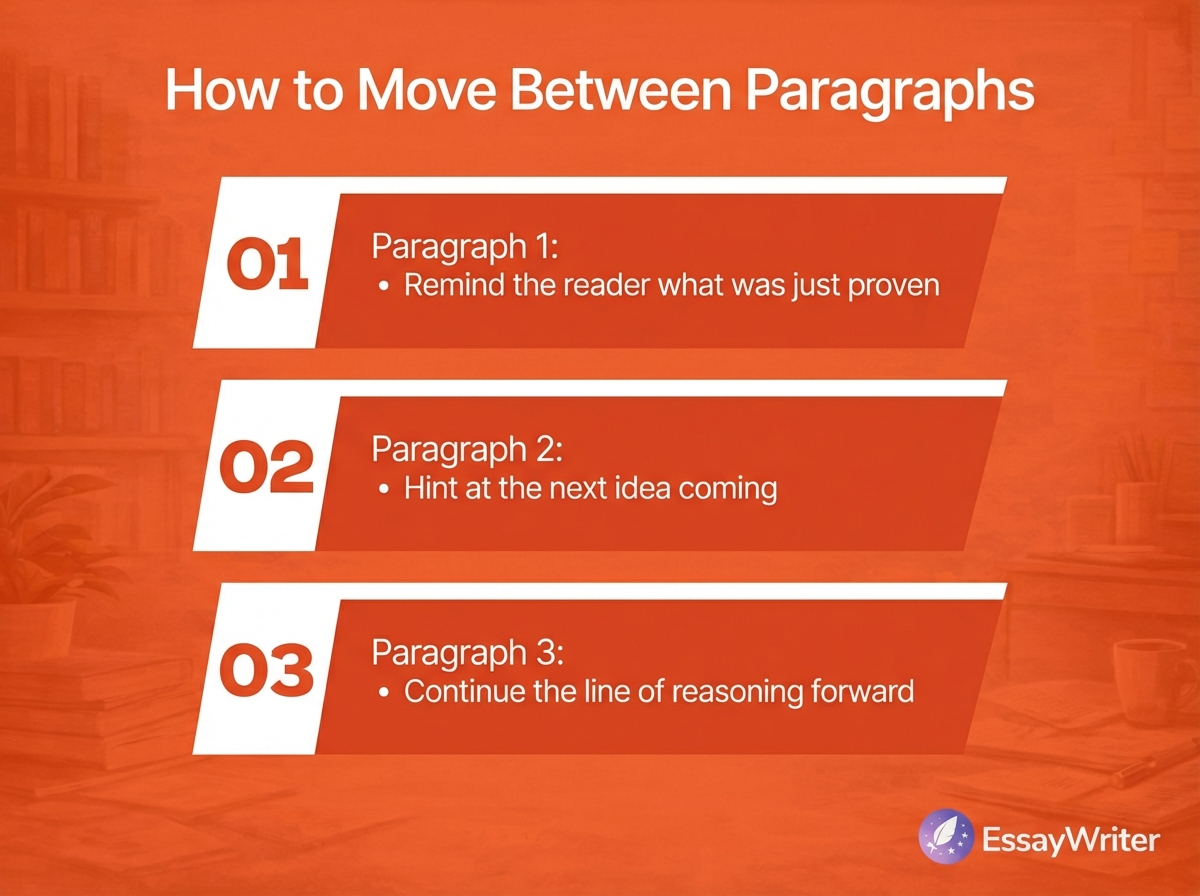
At the end of a paragraph, briefly remind the reader what was just proven, then point to the next idea. Think of it as a handoff.
Bad: 'Another reason school uniforms matter.'
Better: 'Uniforms reduce distractions during class. A second effect appears outside the classroom - they also change how students treat each other.'
Start the next paragraph by echoing one word from the previous point.
Example:
End: 'This policy improves focus during lessons.'
Next start: 'Focus also improves behavior in shared spaces.'
Use short bridge phrases inside sentences: 'because of this,' 'as a result,' 'for the same reason.'
For more revision tips, see our guide on pros of humanizing AI content for cutting filler and tightening sentences.
How to Write a 5 Paragraph Essay
Below is the actual working method of writing a 5 paragraph essay. Follow the steps in order and do not jump ahead. Each step creates something you will directly reuse in the next one, so the essay builds instead of restarting every paragraph.
Step 1. Turn the Topic into a Clear Thesis
Start by rewriting the prompt in your own words. Then answer it directly in one sentence. This sentence becomes your thesis. Avoid background information here. You are deciding what the essay proves.
Ask yourself: 'What exactly am I trying to convince the reader of?'
Weak thesis: 'Social media affects people.'
Clear thesis: 'Daily social media use reduces concentration during studying because it fragments attention, interrupts memory formation, and encourages constant task switching.'
Now you already have three future body paragraphs: fragmentation, memory, and switching. The essay structure exists before writing begins.
Step 2. Build a Three-Point Outline
Take the thesis and break it into three supporting ideas. Each idea must explain why the thesis is true, not just describe the topic.
Write them as short statements, not paragraphs.
Example outline:
- Notifications interrupt deep focus
- Multitasking weakens memory retention
- Habit checking reduces sustained effort
If one point sounds similar to another, combine or replace it. Each paragraph should add something new to the argument.
Step 3. Write the Introduction
The introduction does three things only: introduce topic, narrow focus, state thesis, nothing else.
Structure:
Opening context → narrow focus → thesis
Example:
'Students today rarely study without a phone nearby. Many assume they can concentrate while checking messages, yet attention works differently. Daily social media use reduces concentration during studying because it fragments attention, interrupts memory formation, and encourages constant task switching.'
Notice the introduction does not prove anything yet. It prepares the reader.
Step 4. Write Body Paragraph 1
Take your first outline point and turn it into a small argument.
Structure:
Topic sentence → example or evidence → explanation → mini conclusion
Example:
'Notifications interrupt deep focus during studying. When a message alert appears, attention shifts even if the phone is not opened. Students often reread the same sentence after looking away because working memory resets. This interruption means less material is processed in the same amount of time.'
Do not move to the next idea yet. Fully explain one point.
Step 5. Write Body Paragraph 2
Now continue the argument, not repeat it. Begin by linking to the previous idea so the essay feels continuous.
Start example:
'Beyond interruptions, multitasking damages memory retention.'
Then explain it:
Switching between homework and scrolling forces the brain to store information in short-term memory instead of long-term storage. Students may recognize material immediately after studying, but forget it during tests because encoding never finishes.
Each paragraph answers a slightly different 'why'.
Step 6. Write Body Paragraph 3
The third paragraph usually broadens the effect or consequence. It completes the argument pattern.
Start example:
'Over time, frequent checking changes study habits entirely.'
Explain how:
Students begin expecting stimulation every few minutes. Long readings feel uncomfortable, so they abandon tasks earlier. The issue becomes behavioral, not only cognitive.
Now the reader sees a full progression: interruption → memory → behavior.
Step 7. Write the Conclusion
Do not add new information. A good conclusion for an essay shows what the discussion proves overall.
Structure:
Restated thesis → combined meaning → final thought
Example:
'Concentration problems linked to social media are not caused by a lack of motivation but by constant cognitive switching. Interruptions break focus, weaken memory, and reshape habits. Understanding this helps students change study environments instead of blaming effort.'
The essay now feels finished rather than stopped. The reader should understand not only what was argued but why it matters beyond the assignment. A good ending clarifies the takeaway and leaves a clear interpretation rather than repeating earlier sentences.
Pro tip: After drafting, read only the first sentence of every paragraph in order. If those sentences alone tell a logical story, your structure works. If they don’t, fix the topic sentences before editing the wording.
5 Paragraph Essay Example
Below is a 5 paragraph essay example on a contemporary technology topic. It demonstrates how a clear thesis, focused body paragraphs, and a reasoned conclusion work together in a complete academic response.
Should Companies Disclose When Content Is Algorithmically Filtered?
A social media feed appears spontaneous, as if information simply unfolds in real time. In reality, most major platforms reorganize and prioritize content before it reaches the screen. Posts that seem popular, recent, or widely supported have already passed through ranking systems designed to predict attention. Because these systems shape public understanding, companies should clearly disclose when content has been algorithmically filtered.
The central concern is perception. Users often treat visibility as meaning. When a post appears at the top of a feed, it seems important. When search results repeat similar claims, they appear confirmed. Ranking, however, rarely measures accuracy or public consensus. It measures engagement probability. This difference affects interpretation. Individuals scrolling quickly do not analyze ranking logic; they read what appears first and form conclusions around it. Disclosure would not change the algorithm itself, but it would change how information is interpreted. Awareness encourages evaluation rather than passive acceptance.
Transparency also reduces subtle manipulation. Repetition creates familiarity, and familiarity is frequently mistaken for truth. Coordinated campaigns exploit this psychological tendency by amplifying particular messages until they dominate attention. Without context, users perceive agreement where only amplification exists. A visible notice explaining that ordering depends on interaction patterns interrupts that assumption. Persuasive messages remain present, but the mechanism behind their prominence becomes visible.
There is also a long-term trust issue. Platforms often avoid disclosure because they fear users will interpret filtering as bias. In practice, secrecy generates stronger suspicion than explanation. Many users already know feeds are curated; uncertainty lies in how and why. A concise explanation of ranking factors, even at a general level, replaces guessing with understanding. Trust does not require neutrality. It requires awareness of influence.
Algorithmic filtering itself is necessary. The volume of digital information requires automated organization. The problem emerges when invisible selection is perceived as objective reality. Disclosure restores distinction between arrangement and importance. Users retain convenience, platforms retain efficiency, and interpretation becomes informed rather than automatic. Over time, clarity about information delivery strengthens credibility more effectively than silent optimization.
If time is limited, you can use this AI essay writer to quickly draft a structured starting version.
Final Words
The five-paragraph essay works because each section has a clear role: the introduction sets direction, the body paragraphs prove the thesis, and the conclusion explains the meaning. Following a step-by-step structure keeps ideas organized and easier to develop. With practice, the format becomes a reliable starting framework for many academic assignments.
FAQ
What Does a 5 Paragraph Essay Outline Look Like?
How to Outline a 5 Paragraph Essay?
How Many Words Should a 5 Paragraph Essay Be?
Sources
- Bucks County Community College. (2008). Outline for a five-paragraph essay. https://www.bucks.edu/media/bcccmedialibrary/pdf/FiveParagraphEssayOutlineJuly08_000.pdf
- Monroe University Library. (n.d.). Five-paragraph essays. https://monroeuniversity.libguides.com/essaywriting/Five-Paragraph-Essays
- Touro University Writing Center. (n.d.). A sample five-paragraph essay. https://www.touro.edu/departments/writing-center/tutorials/a-sample-five-paragraph-essay/
Recommended articles

.png)