To outline an informative essay, pick a focused topic and gather information from credible sources. Write an introduction that provides context and ends with a clear thesis statement. Plan body paragraphs around main points, using facts and examples to support them. Finish with a conclusion that summarizes key ideas and reinforces the thesis. Review the order of points and check that sources are cited correctly.
If creating an informative essay outline feels confusing, EssayWriter offers guidance and downloadable tools in PDF format to help you outline effectively and keep your essays clear and well organized. You can also explore good college essay topic ideas to find inspiration before you start writing.
Writing That Thinks With You
Get help that sharpens your ideas instead of rewriting them.
Try It Now

Components of an Informative Essay Outline
A complete informative essay outline template includes four main parts:
- Introduction sets up the topic and purpose
- Thesis statement defines what the essay explains
- Body paragraphs develop the main points
- Conclusion summarizes and reinforces key ideas
Let’s look at what each part includes and how to write it clearly.
Introduction
Start by identifying the exact topic and narrowing it to something that can be explored through facts rather than opinions.
Add short background details that show where this issue lives in real experience. A paper about attention spans, for instance, should hint at both the biology of focus and the influence of digital design. End the introduction by leading naturally to the thesis.
Before moving on, ask three questions:
- Does this section establish a direction?
- Does it define the scope of inquiry?
- Does it set up the reasoning that will follow?
When those are answered, the introduction has done its work.
Thesis Statement
A strong thesis tells the reader what kind of reasoning the essay will use and what principle ties the evidence together.
Say you’re writing about online learning.
- A surface thesis would say it ‘changes education.’
- A better one would specify how: ‘Students who learn online develop self-management habits that traditional classrooms rarely require.’
The second version establishes both the topic and the direction of analysis.
Read the thesis out loud. If it feels general, ask what tension or pattern hides underneath. Maybe the essay isn’t about 'learning platforms’ but about 'how technology reshapes the way attention is distributed.’ Precision always improves clarity.
Body Paragraphs
Each body paragraph carries one step in the reasoning. Start with a topic sentence that signals the focus. Then build evidence that deepens it. Facts are not enough; you need an explanation. Describe why a statistic matters or how two ideas interact
When you mention a source, connect it to a broader concept instead of dropping it as proof. If a study shows that students retain more through spaced repetition, discuss what that implies about how memory organizes time.
Vary sentence structure so your analysis doesn’t flatten. A line like 'Researchers who measure recall rates notice stronger improvement when practice is distributed' adds detail naturally. Another like 'Since the human brain encodes patterns through repetition, consistent scheduling turns information into skill,' shows cause and result without repetition.
At the end of each paragraph, loop back to the thesis. That short return prepares the reader for the next idea.
Conclusion
The conclusion’s purpose is to show what the reasoning revealed that wasn’t obvious at the start. Summarize the main insights briefly, then step back. Ask what those insights imply about how knowledge works in this subject.
If your essay examined study methods, you might note that organization reflects more than academic discipline; it mirrors how memory structures meaning across time. Close with something like: 'When writers design clear outlines, they’re not only planning text; they’re practicing the architecture of thought.'
Here’s a detailed outline template you can use when writing your informative essay. Just make sure you adjust it to your topic and your professor’s requirements.

Steps to Writing an Informative Essay Outline
Before writing a sample outline of an informative essay, you need a plan that defines your focus, organizes your evidence, and makes the logic behind your explanation visible. The steps below show how to create that foundation.
- Define the focus: Identify the exact question your essay will answer and limit its scope so that facts, not opinions, carry the weight. A topic like renewable energy becomes clearer when framed as how solar adoption changes household economics.
- Gather and filter sources: Read widely, but select only what strengthens the line of reasoning you want to build. When you collect, for example, utilitarianism examples in everyday life, mark how each piece relates to your focus. The outline will later show those relationships.
- Form the thesis: Instead of saying ‘climate change affects agriculture,’ state how: ‘Changing rainfall patterns reshape planting cycles that once defined regional economies.’ That phrasing makes the reasoning testable and gives the essay its path.
- Structure the body: Each section should develop one idea that connects back to the thesis. Start with a topic sentence, build with evidence, and close with interpretation.
- Conclude with insight: Write one final section that shows what the explanation uncovered. If the essay traces how technology changes study habits, the conclusion might show that learning tools reshape not only behavior but also perception.
For more structural guidance, check out the 5-paragraph essay outline to see how organization supports clarity in actual academic writing.
Informative Essay Outline Example
Below is a sample outline that illustrates how each section works together from the introduction to the concluding insight. Use it as a guide for organizing your own topic.
INTRODUCTION
Attention Getter:
Every semester, thousands of students stay up late before exams, convinced that longer study hours guarantee better grades. Research tells a different story: how and when you study often matters more than how long you study.
Purpose:
The goal of this essay is to explain how specific study habits influence academic performance and why some methods consistently lead to better learning outcomes.
Importance to Audience:
Students, teachers, and parents all benefit from understanding how study routines shape focus, memory, and long-term achievement.
Thesis Statement:
Effective study habits, when structured around consistency, organization, and reflection, help students retain information, manage stress, and perform better academically.
Preview:
This essay will examine the role of routine, environment, and self-assessment in improving study results, highlighting how balanced habits outperform last-minute cramming.
BODY
- First Main Point: Consistency in study routines improves focus and memory retention.
A. Sub-point: Students who schedule shorter, regular study sessions show stronger recall compared to those who study irregularly.
B. Sub-point: Daily review of material reinforces neural connections and reduces the need for relearning.
C. Sub-point: Tracking progress across sessions helps identify weak areas before exams.
- Second Main Point: Study environment shapes concentration and productivity.
A. Sub-point: Quiet, organized spaces allow sustained attention, while crowded or noisy areas create distraction and fatigue.
B. Sub-point: Lighting, temperature, and physical comfort influence alertness during study sessions.
C. Sub-point: Students who separate their study space from leisure areas maintain stronger mental boundaries between focus and rest.
- Third Main Point: Reflection and self-assessment make learning more durable.
A. Sub-point: Reviewing notes immediately after class strengthens understanding while the material is still fresh.
B. Sub-point: Self-testing encourages active recall, a method proven to increase long-term memory.
C. Sub-point: Students who analyze their mistakes develop stronger problem-solving skills and adapt better in future assessments.
- Fourth Main Point: Poor study habits can weaken academic performance despite high effort.
A. Sub-point: Cramming increases short-term memory but fails to build lasting knowledge.
B. Sub-point: Multitasking during study, switching between devices or messages, reduces comprehension and recall accuracy.
C. Sub-point: Lack of sleep after long study hours lowers cognitive efficiency and retention.
CONCLUSION
Summary Statement:
Study habits directly affect learning efficiency, comprehension, and overall achievement. Students who plan consistent schedules, create supportive environments, and reflect on their progress develop stronger academic performance than those who rely on last-minute preparation.
Concluding Remarks:
Since study strategies can be learned and refined, awareness becomes the first step toward improvement. Students who approach learning with intention and structure build skills that serve them far beyond the classroom.
Tips for Writing an Informative Essay Outline
Once you understand the structure and steps involved, the next stage is refining how you plan and organize your ideas. Each tip below helps you shape your material into a clear, connected framework before you begin drafting:
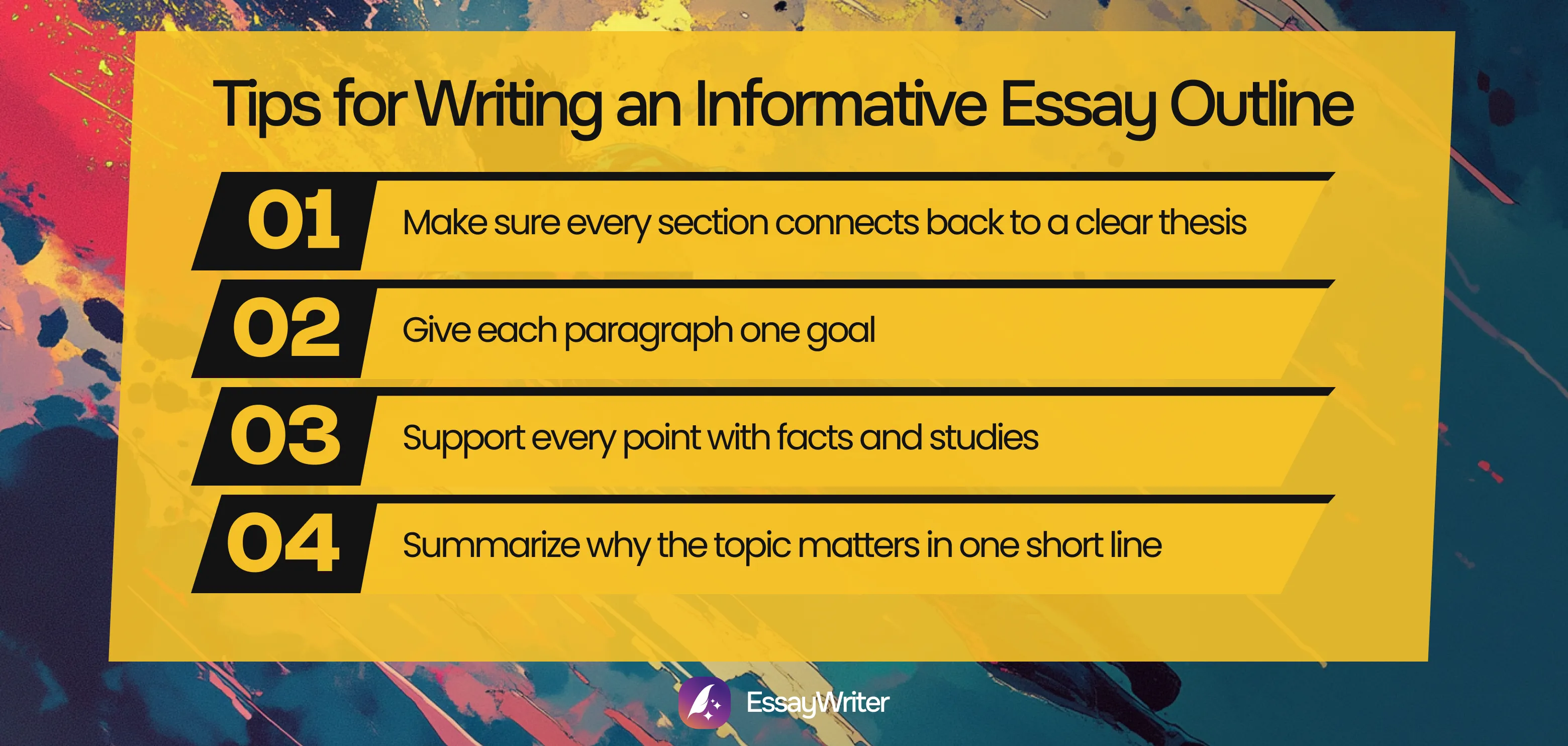
- Write the thesis before the rest of the outline. If your thesis says that 'students who study at fixed times perform better than those who cram,' every section of the outline must relate to that claim.
- Map each paragraph with one main point. Write short sentences in your outline that show what each paragraph will do. Example: 'Paragraph 1 - explain how spaced study sessions strengthen recall.' 'Paragraph 2 - compare spaced study to cramming.'
- Pair every claim with proof. Under each main idea, note one or two sources or examples that will support it. For instance, write: 'Under Paragraph 2 - use the 2016 cognitive psychology study on memory intervals.'
- Summarize the conclusion as a statement, not a restatement. Write one short sentence in your outline that answers why your explanation matters. For example: 'Consistent study habits teach time management that extends beyond academics.'
Final Thoughts
A good outline holds everything steady. The well-built structure gives your ideas a pathway, so you aren’t left wondering what comes next. Once you plan out each section for the essay, the writing part will feel much easier. The intro sets it up, the middle builds your points, and the last section ties it all together.
If you feel unsure about writing altogether, EssayWriter is a place where you can get one-on-one support. The AI tool provides personalized guidance that demonstrates how planning and structure work together to create meaningful essays.
FAQs
What Is the Outline of an Informative Essay?
What Should I Do Before Starting an Informative Essay Outline?
How to Outline an Informative Essay?
How Many Body Paragraphs are in an Informative Essay?
What are the Common Mistakes when Creating an Outline for Informative Essays?
- Bernardloki. (2023, September 14). How to write an informative essay outline. Medium. https://medium.com/@bernardloki/how-to-write-an-informative-essay-outline-502b7afa09b5
- St. Dominic School. (n.d.). Steps for writing an essay. Retrieved October 23, 2025, from https://www.stdomschool.org/stdom/Faculty/Classroom%20News/7A%20Mrs.%20Miller/Important%20Links%20and%20Attachments/Steps%20for%20Writing%20an%20Essay.pdf
- California Baptist University. (n.d.). Informative essay. Student Support Services – Writing Center. Retrieved October 23, 2025, from https://calbaptist.edu/life-at-cbu/student-support-services/writing-center/writing-skills-articles/Informative%20Essay.pdf
Recommended articles

.png)